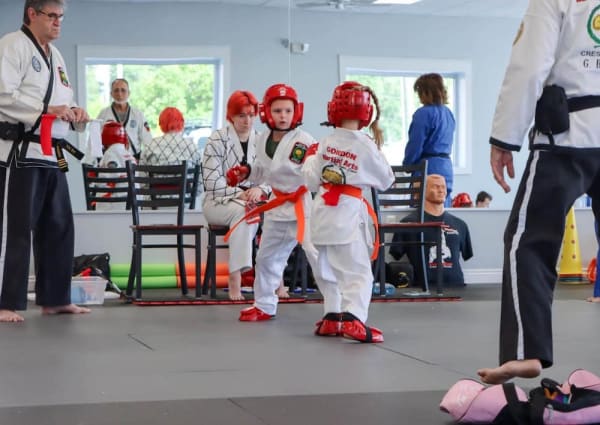
Comparing Martial Art Schools
This is an observation by Master Instructor Thomas Gordon that
he has seen or heard about from people coming into their martial art school.
Researching Martial Art Schools is typically a totally new area
for most people. Here we have listed things to look for. These are things that
we've noticed and our personal experiences. This is a long check list but a
very important step when looking for a martial art school.
The Basics:
School Name:
Phone:
Location:
Website:
Before visiting:
Ask around. Find someone that goes there
or knows someone there. Good or bad, someone else's personal experience is not
necessarily what you will experience. Again, good or bad, it must have some
merit when something is said repeatedly.
Visit Website:
A website does not make a martial art instructor any more qualified, however, it
should give a huge insight into the school and it's instructors.
Is it professional?
Does it list instructors with credentials? This can be complicated.
(See Note)
Are the instructors really instructors or just pictures of students who may or
may not be certified to instruct or even reached black belt? Sadly, some schools
boost XX number of instructors only to find mere children and "future"
instructors running the classes.
Are there pictures of the students or is the website a shrine to the instructor?
Most of us go to church to worship - not to a martial art class.
Look in the yellow pages. Are they listed?
Just because a school has an ad does not mean they are a good selection.
However, having a listing means they are at least legally registered through the
city/county/state. (If not, they will be soon - or out of business.)
About the instructor(s):
This is the singularly most important part of choosing a martial art
school. (See Note)
Knowledgeable Instructors? An older
instructor doesn't necessarily mean a better instructor. There are some very
fine instructors in their late twenties. An instructor in his/her teens simply
hasn't lived long enough to be a veteran instructor. If they stay with it, they
have the potential to be one of the better instructors of tomorrow. Not
boosting, just stating a fact, most of the instructors in this area have
trained/tested under me in some capacity - even those at other schools.
How long have they been doing this?
Where do they train? A non-training
instructor is a dead end. How can they promote if they don't train themselves?
No one is all knowing and past being a student themselves.
Who is their instructor? Are they close? If
not, how often can they train?
Instructors certified? Just because someone
is a "certified instructor" doesn't necessarily mean they are truly qualified.
Some instructors certify themselves! One of the finest instructors I have ever
met was not a certified instructor but had well over twenty years of
active/continuous teaching/training. Nonetheless, an instructor that is not
certified means more emphasis will need to be placed on other areas of your
inquiries/research.
Are the instructors CPR (or similar) certified?
With the inherit risks of any contact sport, anyone coaching/teaching should be
CPR (or similar) certified.
Making the visit:
After you have narrowed the list down to a few prospects, visit the
school. After narrowing it down to one or two, see if you can try a few classes.
Here are some things to look for when visiting a school.
Courteous Instructors? If looking for your
child - this is the person that will be teaching your child and many times could
be a significant role model in your child's life. If looking for yourself - you
are a paying customer and looking for a professional service. There is a
delicate line between customer and student but most of us want to avoid the
antiquated ways of teaching with patronizing, and almost brutal instructors that
was an accepted form of instruction some years ago.
Courteous Students? These are fixing to be
your extended martial art family. Do you want to associate with them? If looking
for your child, do the current students display what you want your child to be
like or be around?
Separate classes for children and adults?
Some mixed classes are okay but children and adults learn differently. And most
programs teach adults more "adult things."
Classes split up by rank? Much like age,
mixed classes are okay but higher ranks need to work on different things.
Smaller schools can overcome this, but classes should be split once there are 20
or more students in a class.
Well lit and clean facility? A professional
facility is going to cost more but you typically get a higher quality of
instruction.
Well lit and safe parking area? You are
supposed to learn martial arts IN class...not be forced to "put it to use" while
trying to beat muggers off in the parking lot.
Location convenient? Personally, I've driven
70 minutes one way to train on a weekly basis and, at times, 2-3 times a week.
In fact, the last four places I've trained was at least an hour away. So
location takes a far back seat to a quality instructor. However, most of us
aren't willing to drive that far and a good location in a good part of town is
important. (see parking area from above).
Stand alone location? Gyms, churches, rec
centers, community centers may offer martial art classes. Typically these
are part time instructors. And there's nothing wrong with that so long as
you understand that you're getting someone that doesn't dedicate 100% of their
efforts to training people in martial arts. With that said, we've had some
fine instructors guest instruct at our own school who taught out of a community
center. More times than not, we find these are young and inexperienced
instructors. Ask how long they've been at that location. Martial arts
works on a progression system. Once you get started, you don't want to
change. That's like getting 2-3 years in a college program and the college
decides to stop offering that particular degree.
Things to ask (if you haven't
already found the answer):
Hours of operation? Are they convenient for
you or your child? Will the schedule work with you and your child's needs and
schedule?
Are the students insured? As mentioned
above, there is no reason to be overly cautious but we should still be mindful
that there is an inherent risk associated with martial art training. Although
I've only seen a handful of people get injured (and none of them serious),
insurance could be critical should something happen.
Contracts without a reasonable escape
clause? Contracts are a part of life. They aren't so bad if done
correctly. A contract should lower the consumer's price by giving some guarantee
of revenue for the instructor. Bottom line, the lights have to stay on and
running a first class program does take money. With that said, a contract should
also have a reasonable escape clause such as moving, unable to continue
training, or financial hardship.
Contract transferable/cancelable?
What
happens if you move or they close down? Is the contract transferable or can it
be voided? Don't take anyone's word for it. Ask for it IN WRITING. A
local school closed with many students that had pre-paid for an entire program.
What the found was no one (even the schools in the same organization) would
honor their prepayment. From what we were told, the organization turned a blind
eye and would not help the students other than direct them to another school who
could not accept them at no charge. To that particular instructors credit, he
did try to help them the best he could. These particular students were lucky!
Buyer beware!
Training requiring purchase into a
additional programs? We've heard so much about programs and mandated
upgrades where the student starts out paying a rather low price and then
suddenly finds they're forced into much more expensive programs in order to
progress and train. The latest trend is to sign up a student on the low
monthly rate and then drop some expensive
program on them. Or a program that teaches part of the curriculum but will not
carry the potential student to black belt. We've been told from parents that some schools push programs
so hard that parents literally leave their wallets at home to avoid the pressure
of "pre-purchase" a black belt or some other program.
Be very leery if approached by a
salesman, if you can't get ALL the prices for training (what are they hiding?),
or a continual push for a "conference." Please
understand, if you're getting additional services, you should expect to pay
more. But there should never be a mandate of "join our XYZ club or stop
training."
Payment options? Can you pay monthly, six month block, year in advanced, by the class, etc. Can you pay
by cash, check, credit card, or direct deposit? No real input here. There are a
lot of ways to do business but options are nice. With high failure rate in
martial art businesses, be careful not to pay too far in advance.
Cost of classes? Monthly cost of classes
range from $35 to $250 depending on the curriculum, instructor, facility, and location.
This is something that you'll want to know but shouldn't be surprised if a
quality program has a higher price tag. Personally, I couldn't fathom paying
$250 a month but there are obviously people out there who will.
Cost of testing? Color belt testings range from nothing
(fee included in monthly curriculum cost) to $95. The testing typically includes
the belt, certificate, and cost of the exam itself (lights on, instructor's
time, guest instructor, etc). In 1991, the cost of a white belt exam in a local
school was $45. Now, in 2004, I'm told that the cost of a white belt exam in
some schools is closer to $75.
Cost of black belt examination? Black belt
exams range from $35 to into the thousands. In 1991, the cost for a first degree
black belt in a local school was $125. Now, in 2004, I'm told the cost for a
first degree black belt exam in some schools is closer to $600, after the cost
of midterms (not including travel/lodging expenses).
Where are testings held? (ALL testings?)
This can be critical. It doesn't matter if the black belt exam is free if you
have to drive/fly halfway across the country to test. For example, in 1994, I
traveled to a tournament where upper black belt testings were being done. I was
not testing but I did pay $45 to compete. By the time I paid for travel, hotel,
and food, I had spent close to $500 for a weekend plus I missed two days of
work. Take your family and watch that number grow rapidly.
Cost of sparring gear? Sparring gear
typically ranges from $90 to $190 depending on what you choose. Everyone likes
to get a better deal and the internet is full of websites that sell sparring
gear. Many times the gear is second rate and can not be returned unless you pay
a fairly healthy postage/handing fee. Since martial art sparring gear doesn't
conform to standardized sizes, it's best to buy your sparring gear from your
local school, but the price should be inline with catalogs from Century, Asian
World, etc.
Tournaments required? As mentioned above,
getting to tournaments can be expensive. Tournaments are a great opportunity to
meet people and test your skills. It shouldn't be mandated though. Some
organizations require participation, and at times, unreasonable mandatory
participation.
*Note. There are many things we've noticed while training in the martial
arts. This tends to be the dirty side of our industry but a fact of life. Be
very careful when you see words like Hall of Fame, Grandmaster,
state/national/world champion, Doctor, or Vietnam Special Forces.
Hall of Fame. How many Hall
of Fames (HOF) are there?! Some are the real deal but any HOF that basically
requires a payment to be inducted should be avoided. Many of these HOF will
induct martial art celebrities to give their HOF legitimacy. Then the HOF
inductee can claim, "I got my HOF the same year Chuck Norris did." Only problem
is that it's very likely Mr. Norris didn't know about the HOF or didn't have any
interest in claiming it. When someone claims "Hall Of Fame," ask them from where
and then check it out. There are many HOF out there and I've personally been
nominated and even guaranteed placement. One HOF very plainly told how
submitting payment was guaranteed placement. Go to google and type in
"Martial Art Hall of Fame" and see what you get. (Also, please note, I
declined the offers.)
Champions. I was reading one advertisement
and a school claimed over a dozen world/national/state champions. Wow! That's
impressive. That was until I saw it came from a "champion mill." This one
organization generates about 4000 "champions" every year in the United States
alone! In this organization, more than forty percent of the states have well
over 100 "state champions" with roughly 156 "world champions." Several states
showed everyone that competed was in first place and many of the state champions
had only competed in one tournament and/or was in the division by themselves. In
effect, a person could walk out in front of the judges and fall down on their
face and STILL get "state champion" because they are the only one in that
particular division? I've also personally seen a person win an international
tournament's master's division because there wasn't anyone competing against
them. When you hear "champion," ask how many people they competed against to
earn the title.
Locally, there is a black belt claiming world champion status.
When researching it, in 2007-2008 competition year, looks like he is one of four
in the entire world for that particular division. Kinda takes the shine
off of world champion when we can fit the entire division comfortably in an
elevator.
In fairness, is it their fault it's a small division. They
beat everyone that showed up - but don't go around crowing because they managed
to beat three other people...and then call it a "world championship."
With all of that said about champion titles, there are some very
fine martial artists who worked very hard and earned the title. These
organizations that mass-produce champions is a disservice to those that worked
hard.
Vietnam Special Forces. These are the men
that fought for our country and I've met some very fine instructors
that served in Vietnam. However, seems there are many "special forces" guys
making video tape series these days. Needless to say, buyer beware when a
30-40ish something man that claims to have been in Vietnam.
Grandmaster. Typically,
grandmaster is a title for a ninth or tenth degree. Typically, it takes 35+
active training years to earn that rank. Sometimes a person is granted ninth
degree for creating a new martial art but that's fairly rare. Be leery when you
see a 25 year old sporting a "grandmaster" title.
Doctorate of Martial Arts. To my knowledge,
there isn't an accredited college with a doctorates program in martial arts. I
researched this and found "doctorates in martial arts" for as little as $19 and
as much as several thousand. One required several one page thesis' before the
doctorates was issued. One "respectable" martial art university told me that I
automatically qualified for a MA (for $550) and if I submitted two one page
papers (and $990), I could get my PhD. So when you hear or see, "Grandmaster,
Dr. SuperBadBoy," inquire what school they went to and did it take them eight
years of college study/courses to acquire that title.
Well, that pretty much wraps it up. I bet you didn't realize how much was
involved in picking out a good martial art school! How much something costs is
important but, as you can see, there is a lot more than the monthly/testing
fees. As in all businesses, while the majority of people are honest and run a
clean program, there are always unscrupulous people out there trying to take
advantage of unsuspecting people.